
SLIDE 1
Personal intros tailored to event/audience highlighting role of the English Project .
Delighted to have the opportunity to talk to you about both the historical Captain Swing riots of 1830 and our plans for the Bicentenary commemoration – and, indeed,how the audience might like to become involved.
SLIDE 2
So The year 2030 will mark the 200th anniversary of the Captain Swing Riots which consumed the rural areas of southern England in the Autumn of 1830.
Our goal is to commemorate this important but largely forgotten event in the history of Southern England. It is a rich and multilayered tale with enormous potential for story-tellers. And there are four main reasons for doing it:
SLIDE 3
– first, the Riots were a highly significant event in the industrial history of southern England. When people talk about ‘industrial history’ they tend to think of the north and mines and factories. But the south has an industrial history too – the story of a struggling and exploited agricultural working class. But they have been marginalised – that needs to change. For once they need to be in the foreground.
– second, the events of the riots are full of fascinating stories about individuals, about village communities and about places. They tell us a lot about the background and the history of the Hampshire where we all live today.
– third; the issues that arise are still with us. They are about the impact of technology, the relationships between the social classes and, above all, how we deal with change
– fourth (and this could hardly be more topical) they are about how crowds of ordinary people with grievances can be transformed into a raging mob – become what I call ‘riotoxicated’ – and then how the authorities and the justice system deals with that. What could be more pertinent to what we have recently been dealing with?
So as you will see, there are deep parallels between events in 1830 and what happened in the Summer of 2024. Both sets of Riots – the 1830s and 2024 – pose the question what happens when a sizeable minority feels deeply alienated from the authorities and the pace of social change, and is prepared to adopt violence to achieve protect and assert their rights. And, after that, how does the policing and justice system respond?
In outline, then, this is what happened.
SLIDE 4
From late August onwards in 1830 until the end of the year – and especially in the Autumn months – rural southern England from Kent to Gloucestershire and up into East Anglia was consumed by the burning of farms, the destruction of factories and poor houses and, most notably, the breaking up of agricultural equipment. This mostly happened at night by large numbers of men and was often terrifying in its nature. Meanwhile, during the day, there was widespread intimidation of farmers, their wives, the clergy and the gentry. The normal relationship between the different classes collapsed and the traditional social cohesion ripped apart. Although the towns were largely unaffected in the countryside it was class war on a major scale.
The number of rioters involved across the whole country was enormous. Angry crowds of predominately agricultural workers turned into large mobs who rampaged across the countryside from Kent to Sussex to Hampshire and then points further north and west. East Anglia too was hugely affected.
Fired up by legitimate grievances after a decade of what was called ‘agricultural distress’ in the aftermath of the Napoleonic Wars, the agricultural labourers and their allies made clear their demands – wages should be raised, the tithes paid to the clergy should be cut and the use of new-style agricultural machinery – primarily threshing machines – should be stopped. Alongside that there needed to be major changes in the way the unemployed were supported.
These complaints had been rumbling on for years and had been reported on by radical journalists and commentators such as William Cobbett and Henry Hunt. Indeed Cobbett had predicted that a social explosion was inevitable especially in the absence of political reform to Parliament and the ever-increasing taxes. He actually predicted, a year or two ahead, that the crisis would explode in late 1830.
Cobbett also raged against the tithes. Prices for produce were going down but the clergy would not reduce their traditional expectations.. As Cobbett had observed as far back as 1822 in a speech he gave in Winchester in the Black Swan hotel on the corner of the High Street and Southgate Street. The parsons, he complained, are proposing “reducing the wages of labour to a mark so low as to make the labourer a walking skeleton.”
In fact rural areas like Hampshire had been in decline and overlooked pretty much since the Battle of Waterloo. Soldiers coming back to their villages after the war found it hard to find new employment. Local newspapers like the Hampshire Chronicle were full of the stories of ‘Agricultural Distress’ as prices
went down. Great agricultural fairs such as that at Weyhill near Andover were pale shadows of themselves. The system of poor relief was broken so that pauper families with a handful of children could barely survive.
Meanwhile incoming wealthy bankers and other business people who earned their fortunes elsewhere were arriving to buy up farms and, directly or indirectly, introducing new technology to run them more efficiently. That was embodied in the arrival of the threshing machine on a large scale. This was a huge technological leap-forward and by the late 1820s in the south it was being adopted by an increasingly large number of farmers. But it was the death knell for jobs especially in the Autumn months. A vital part of the agricultural labourers’ income had disappeared at a time when the weather was making life more difficult. As one historian has commented, “The conjunction of a growing population with little alternative to agricultural work and the introduction of the threshing machine–much the earliest machine of any importance in English farming- resulted in chronic winter unemployment and distress in southern England.”
So by the Autumn 1830 things had reached rock-bottom. This was succinctly expressed in a petition to the new King, William IV, from workers in Barton Stacey, Bullington and Wonston in September 1830 who described their position as follows:
“Many of us have not food sufficient to satisfy our hunger, we have not clothes to hide the nakedness of ourselves, our wives, our children nor fuel wherewith to warm us. To our great sorrow and disappointment we find oppression daily press heavier and heavier upon our shoulders till at length we are driven to the brink of despair.”
It was this depth of despair with no obvious sign of relief or improvement which created the conditions for an uprising. But what became extraordinary about the Swing Riots was the way the violence spread out like a wave gaining momentum as it went along and involving more and more people. And from county to county it became part of the same movement – and that movement, it appeared, was under the direction of the mythical Captain Swing.
SLIDE 5 – Swing Image – Arsonist
Of course this was a fiction. It followed in the tradition, some 20 years earlier, of so-called General Ludd who mobilised the Luddite destruction of looms and knitting frames in the Midlnads and the north. But the apparent co-ordination of unrest across vast distances convinced the authorities that there really was some kind of sinister, controlling figure orchestrating everything.
The first spark was lit in the county of Kent near Canterbury at the end of August and the beginning of September. This was when the destruction of the first threshing machine occurred. Now, in due course those responsible for the outrage were caught and tried towards the end of October. But to the astonishment of most people the sentences handed out by the judge in east Kent to the seven convicts was trivial – a mere three days in gaol and a mild telling off not to do it again.
Such leniency might have been kindly meant. But the interpretation by a disgruntled working clas was clear. It meant that the destruction of threshing machines was not taken seriously by the authorities. There would be no serious repercussions for the culprits. The starting pistol had been fired on the explosion of mass rioting and within days threshing machines were being destroyed all over the county.
What’s important, I think, is that although hundreds of ordinary labourers soon became caught up in the unrest it is believed that many of those who first took to violence were men who had a previous record of crime – notably organised smugglers and poachers. These activities were the equivalent of drug-dealing today. The people involved did not have a regard for the law. The evidence is that it was these types who first got the momentum going.
SLIDE 6 – Swing Letter
But it was a powder keg waiting to explode and very quickly the figure and name of Captain Swing appeared as the author of letters threatening the burning of farms and the destruction of machinery. Swing – with its implications of execution but also, maybe, a reference to the swing of the thresher – was the sinister embodiment of an all-powerful avenging angel come to wreak havoc over the prosperous rural classes. This letter for example demanded that a farmer destroy his own threshing machine or that it would be done for him. It was signed by ‘The Whole Swing’.
Use of the Swing ‘brand’ as a threat soon spread and drew together what might have been seen as random acts of violence into a popular – and maybe even revolutionary movement. The mystery around the name and the implication of co-ordination added to the menace as the violence spread from Kent into Sussex and then on into Hampshire in November with the first Swing activity happening in the Havant area. Interestingly enough although there were almost no women involved in the actual violence it was believed – and in some cases proved – that the hands behind the letters were those of women – the equivalent maybe of the recent women keyboard warriors sent to gaol.
SLIDE 7 – SWING HANGMAN
It was not just farmers or the local gentry, however, who came under threat – although mostly they were the targets. Some of the demands began to extend beyond the scope of agriculture. And maybe one of the most famous SWING missives of all was issued in Hampshire to the Duke of Wellington in the first week of November. At this point – but not for too much longer – the Duke was the Prime Minister as well as being the Lord Lieutenant of the County of Hampshire and the context was political. {4 November 1830 MS 61 WP1/1159/93} This was what the Swing letter to Wellington said:
“Your base vile conduct and treatment of your fellow subjects; your determination to turn a deaf ear to their remonstrances, has made you an object of popular vengeance and of popular hatred. Take my advice, act openly and nobly, as becomes a Briton, reform that vile nest of corruption which is bred in Downing Street, destroy those vultures that prey on the public liver or beware – I say beware, beware, beware.”
It was signed Swing.
So what had started out as individual acts of revenge or violence turned into a bandwagon of anger and agitation which was jumped upon by a variety of people – including those with a big political aganda.
Indeed, alongside the experience of agricultural decline there had also been a process of political education and agitation taking place. This was particualrly true of Hampshire where the hotbed was Sutton Scotney and along the Dever valley.
Here the writings and activism of William Cobbett had been devoured for years at the meetings of the self-proclaimed Radical and Musical Society. This met in the White Swan pub on a regular basis to drink, sing and to hear radical readings from William Cobbett’s newspaper The Weekly Register. The people involved had a heightened level of political awareness – they wanted change not just to agriculture but across the board. And once the riots exploded members of the Radical and Music Society were often to be found in the forefront.
So we reach a point in the mid Autumn when the riots were debated in Parliament. Wellington as Prime Minister declared that he “should imagine that the outrages were carried on by two different classes of people. Some of the offences had been committed by a class which was always disposed to break machines, which they thought would throw them out of work although they did not see that eventually improved machines would not interfere with their labour except to better their condition.
But, continued Wellington, there was another very desperate class of persons who burnt and destroyed property without any visible motive whatever.
Ministers were doing every thing in their power to help the gentry and magistrates to discover the causes, and they were giving them every assistance they required to put the law in force, and to put down the disturbances as quickly as possible.” END OF QUOTE
SLIDE 8 – SWING LETTER
The reality was that – although the ruling classes did not understand it – ordinary people wanted profound change and were prepared to use force to achieve it. That letter to Wellington in the first week of November was followed up by a further letter to him at Stratfield Saye on the 16th November. ‘To Wellington’, it was addressed, ‘Parliamentary Reform in a full and fair representation of the people – Or Death. Mark this thou despot’ it read. Again it was signed ‘Swing’.
This letter was especially significant because it was sent on the day that Wellington was finally turfed out of Downing Street because of his adamant refusal to countenance any kind of political reform.
No longer the leader of the country Wellington immediately resumed his role as Lord Lieutenant of the county of Hampshire. Having been infuriated by what he saw as the weak and woolly actions of the authorities in Kent in Sussex he resolved to run things differently back here.
SLIDE 9 – WELLINGTON BUST
So Wellington’s figure now comes to dominate the story of Swing in Hampshire. And remember that across the Channel in France during the Summer of 1830 a second Revolution had been taking place which led to the overthrow of King Charles X, the French Bourbon monarch. Had the rebellious fever in France come across to spark off the long feared English Revolution, Wellington was thinking? One can understand why the political class – and the Duke of Wellington in particular – became increasingly worried about where this was all leading.
SLIDE 10 – MAP
By now Captain Swing was active almost everywhere across the Hampshire countryside. As an historian of the Riots observed, “It was in Hampshire and Wiltshire that the movement, as it drove westwards, became the most widely dispersed and attained its greatest momentum.” Hence on 17th November there was arson directed at farmers in Droxfod, Hamble and on Portsdown Hill. Meanwhile in Whitchurch, Laverstoke and Freefolk there was riotous assembly. And then the following day there was the first example in Hampshire of the burning of threshing machines in Emsworth, Warblington, Havant and Leigh.
And so it want on for the next ten days or so, every day more violent than its predecessor and impacting on some of the most senior people in the county. The result was that by the time that the riots had hit hardest in Hampshire in late November more than seventy village communities were involved.
Out in the fields at night many of the men involved found themselves carried along by an impersonal wave of violence often admitting afterwards that they did not know what had propelled them to such extremities – again anticipating some of the explanations we have heard about our own recent riots. But in the course of a couple of hours their lives had changed for ever.
So now let’s take a look at some of those stories in a little more detail.
SLIDE 11 – CHARGES
And let’s begin with that prime object in Hampshire of the rioters’ hatred – the agricultural machinery factory which had been started by the Taskers Brothers in Upper Clatford a few years earlier. The business was doing very well and was offering employment to men in the village and from Andover. But it was also seen as the source of the machinery which was putting other men out of work. So a mob gathered at night to destroy it as illustrated by a warrant for six of the rioters, all young men aged under 28, who – [as you might be able to read]
“on Saturday, the 20th of November at the parish of Upper Clatford , in company with other persons to the number of 300, riotously and tumultuously assembled together , and then and there feloniously pulled down and destroyed several machines used for the purpose of casting iron and other machinery; for the making of ploughs , and other articles used for husbandry purposes; and with having feloniously pulled down and destroyed certain buildings used as a foundry, stable, and blacksmith’s shop, the property, goods and chattels of Robert Tasker and William Tasker of Upper Clatford aforesaid iron founders.”
Within less than a week arrests had been made of these men showing that the arrival of the Duke of Wellington had an immediate impact on the policing measures. Small detachments of regular cavalry assisted local landowners and magistrates in controlling the rioters and then apprehending them. The riots also prompted the recruitment of troops of yeomanry and these were to be followed by newly raised troops across the county including Andover, Basingstoke, Winchester and Alton. Wellington was cracking down hard and overseeing a very effective programme of arrest.
This included, for example, even individuals who had nothing to do with rick or farm-burning but just intimidation and theft. This was the case of a man by the name of William Adams one of the Rioters caught up in the events and arrested for rioting in Owslebury in November 1830. Aged 35 he was a shepherd with five children.. He was accused of assaulting a well-off local neighbour by the name of Moses Stanbrook. As the charge put it, Adams put Stanbrook ‘in bodily fear and danger of his life and stole from him a £5 note’ – a very substantial sum of money in those days. Adams was also accused – like so many other men – of ‘riotous assembly and making a great noise to the terror of the king’s subjects’. As a result ADAMS was initially given a death sentence – but that was commuted to transportation for 14 years.
In his defence Adams claimed that he had been pressed by others to join the mob. Not persuaded – but pressed. He was then swept along by the crowd. He had not planned ahead to attack Mr Stanbrook – on impulse it just happened in the spirit of the evening. It was the kind of defence we have heard often recently.
When it came to conscious and planned riot and destruction, however, there is a stand-out example from the other side of the county – Headley near the border with Surrey.
In this case the target was not a farm or a threshing machine – it was the local Union Poor House. The poor laws were regarded with loathing by many of the unemployed farm workers and the poor houses were the concrete expression of the system. On the other hand they were a place which afforded some shelter and security to the most vulnerable members of the community. This did not stop Robert Holdaway, a local carpenter from leading a mob to destroy the building. As was described by the judge at Holdaway’s trial.
“You and your associates made an attack on the Poor House at Headley, under circumstances capable of melting even the hardest hearts.You collected a mob, most formidable from its numbers, for they varied from 1400 to l,700 persons. You went with this mob armed with various offensive weapons, to Mr. Shoesmtih, the overseer, a person against whom you could have conceived no personal resentment. You ought to have recollected the condition of the poor children who were sick in bed, and without any other roof lo shelter them from the inclement weather of November than that which you were determined to pull down. You had those circumstances before you. You knew the numbers that your outrageous violence would render roofless , and yet, deaf to all the remonstrances which were made on their behalf, you determined to execute your desperate design with a deliberation which was atrocious.”
Hence it came to the legal reckoning at the end of the year. Previously, in the eastern counties, a variety of small scale trials were convened with a handful of cases being heard. That was NOT how Wellington was going to do it in Hampshire. Instead he was going to go big. With the backing of the Government in London the first step was to bring all those who had been arrested to the county gaol in Jewry Street in Winchester to await a Grand Assize in what the Italians today would call a maxi-trial.
SLIDE 12 – LIST OF THE ACCUSED
A total 300 men were then tried over a period of about 10 days in the last fortnight of the year stopping only briefly on Christmas Day. The trial was held in the Great Hall and for the duration the town was packed with the families of the accused.
To give definitive weight to the Grand assize panel of high powered judges was brought down specially from London for the purpose of handing out severe sentences.
SLIDE 13 – CALENDAR OF PRISONERS
You can see the names there – Sir John Vaughan, Sir John Parke, Sir Edward Hall and overseeing them the Duke of Wellington, the Lord Lieutenant of the County, himself.
There were also 65 magistrates in attendance and the official record stated that ‘A larger number of the gentry of the County there had never before been witnessed.’ This was partly because – to test the evidence – a Grand Jury had been assembled consisting of the most prominent local Members of Parliament and magistrates including people like Sir Thomas Baring MP, Sir Henry Tichbourne and Sir William Heathcote MP. This was the local establishment who had themselves been targets of the rioters brought in to be part of the court system.
As a report of the trial described it, “This City presented an unusual appearance of bustle at a very early hour this morning. Persons were flocking in from all quarters. The gaol was surrounded by the wives and families of the unfortunate men confined there. Most of them appeared in the greatest distress. It was a painful sight to see so many apparently respectable persons in such a situation. An immense number of County Magistrates arrived during yesterday and in the night, and soon nearly filled the court which had been fitted up with great care and attention to the convenience of those who were there on business. The Attorney General and Mr Sergeant Wilde arrived on the 19th and had a consultation in the evening with the other gentlemen retained on this occasion. Precisely at ten o’clock, the three judges entered the court attended by his Grace the Duke of Wellington.”
Such a trial inevitably attracted great media attention and, indeed, the court authorities in Winchester beat over backwards to ensure that journalists were allocated good positions in the court room. Justice was to be seen to be done by the press – and reported widely. Even so the representative of The Times of London was astounded by how much he had to pay for a room at an inn in the cathedral city as well as the inflated prices of food in the eating establishments – so pretty much like today then.
But for those facing trial it was a grim experience in every respect. Having been crammed up in the gaol for some weeks they were taken in groups up to the Great Hall to face the evidence against them. The trial itself was, as you might imagine, full of drama – too much to discuss here but rich in potential for dramatic purposes – including one witness who jumped in amongst the accused to stand in solidarity with them. But with 300 men being processed in 10 days you can imagine the speed with which the jurors came up with their verdicts.
SLIDE 14 – REWARD
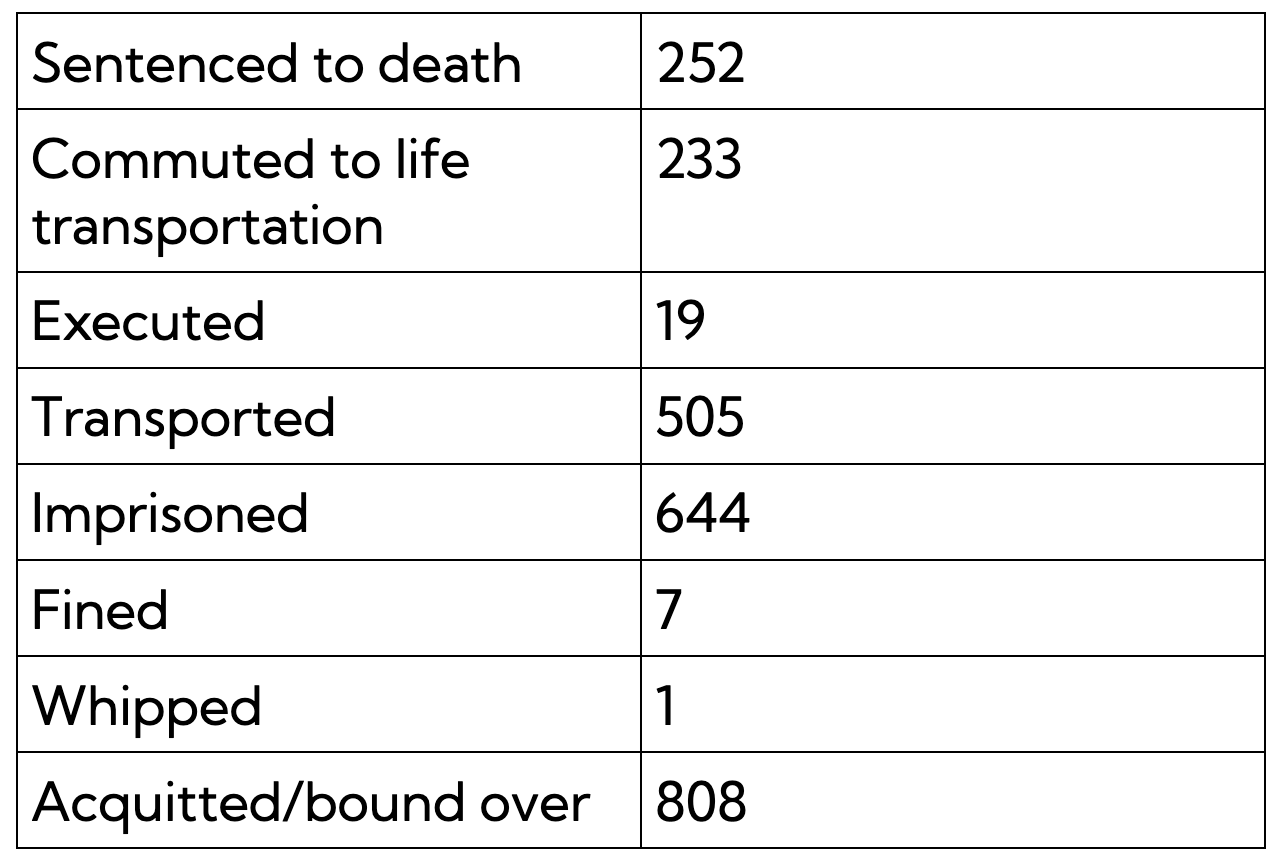
Not everyone, it must be said was found Guilty. Despite rewards being offered for evidence sometimes the jurors were not convinced. But for those were convicted the consequences were mostly very serious. This meant, predominantly, transportation to Australia for 7 or 14 years or, in some cases, for life. And in a small number of cases actual execution. As the Senior Judge observed, “The law delights not in punishment; the object of the law is the prevention, rather than the punishment, of crime ; BUT Those who are the first and foremost in an aggression of the laws, must expect to be made first. and foremost in the punishment.”
SLIDE 15 – SENTENCES
The judge then went on to add in another trial “They had heard it said that these riots had arisen from distress; but destroying machinery was not the way to make the distress less. He feared it was true that there WAS great distress among the agricultural classes; but yet this was not to be a reason for committing breaches of the peace.” Again we might bear this in mind in the context of our own recent riots.
IN TOTAL FOR REFERENCE ONLY
So there we are. Memories of the Swing Riots can resurface in unexpected ways. For example, as some of you might have seen on television a little while ago, the series Who Do you think you are? featured the actress Lesley Manville who, it turned out, had an ancestor who had been involved in the riots and was then tried in the Grand Assize in the Great Hall. He ended up being transported to Australia. As this was revealed, Manville was overwhelmed by the discovery and almost wept on camera.
So when it is told and given profile the Swing story can still has resonance today. And that is what we plan to feed off for our Bicentenary Commemoration project. Already we are doing lectures around the county especially to local history groups. But we have have plans and aspirations for exhibitions, art projects, smaller scale drama events and so on with a view to this all culminating in 2030 with a major series of events including something quite dramatic in the Great Hall where the original Grand Assize was held.
I am now going to hand over to my colleague Professor Bill Lucas , the chair of the English project,to outline some of the ideas we now have and which may be of interest to you.

